Note
Go to the end to download the full example code.
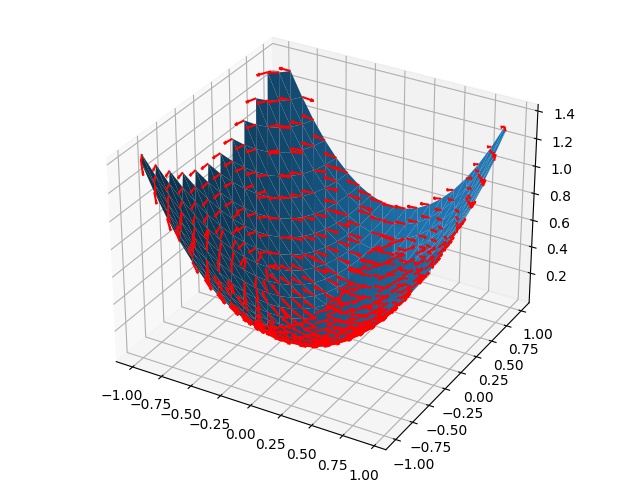
example of curvature directions in slam
# Authors: Julien Lefevre <julien.lefevre@univ-amu.fr>

# License: MIT
# sphinx_gallery_thumbnail_number = 2

# importation of slam modules
import slam.generate_parametric_surfaces as sgps
import slam.curvature as scurv
Create quadric mesh
nstep = 20
equilateral = True

K = [1, 0.5]
quadric_mesh = sgps.generate_quadric(
    K,
    nstep=[int(nstep), int(nstep)],
    equilateral=equilateral,
    ax=1,
    ay=1,
    random_sampling=False,
    ratio=0.2,
    random_distribution_type="gaussian",
)
Compute principal directions of curvature
PrincipalCurvatures, PrincipalDir1, PrincipalDir2 \
    = scurv.curvatures_and_derivatives(quadric_mesh)
Calculating vertex normals .... Please wait
Finished calculating vertex normals
Calculating curvature tensors ... Please wait
Finished Calculating curvature tensors
Calculating Principal Components ... Please wait
Finished Calculating principal components
VISUALIZATION USING matplotlib
import numpy as np
import matplotlib.pyplot as plt
Visualization of vector fields with matplotlib
def visualize(mesh, vector_field, colors=None, params=None):
    """
    Visualize a mesh and a vector field over it
    :param mesh: a mesh with n points
    :param vector_field: (n,3) array
    :param colors: (n,3) array
    :param params: params[0] is the length of the quivers
    :return:
    """
    n = mesh.vertices.shape[0]
    if colors is None:
        colors = np.zeros((n, 3))
        colors[:, 0] = 1
    if params is None:
        params = []
        params.append(0.1)

    ax = plt.figure().add_subplot(projection='3d')
    ax.plot_trisurf(
        mesh.vertices[:, 0],
        mesh.vertices[:, 1],
        mesh.vertices[:, 2],
        triangles=mesh.faces,
        shade=True,
    )
    plt.quiver(
        np.array(mesh.vertices[:, 0]),
        np.array(mesh.vertices[:, 1]),
        np.array(mesh.vertices[:, 2]),
        vector_field[:, 0],
        vector_field[:, 1],
        vector_field[:, 2],
        length=params[0],
        colors=colors,
    )

    return ax

visualize(quadric_mesh, PrincipalDir1)
plt.show()
Total running time of the script: (0 minutes 0.564 seconds)